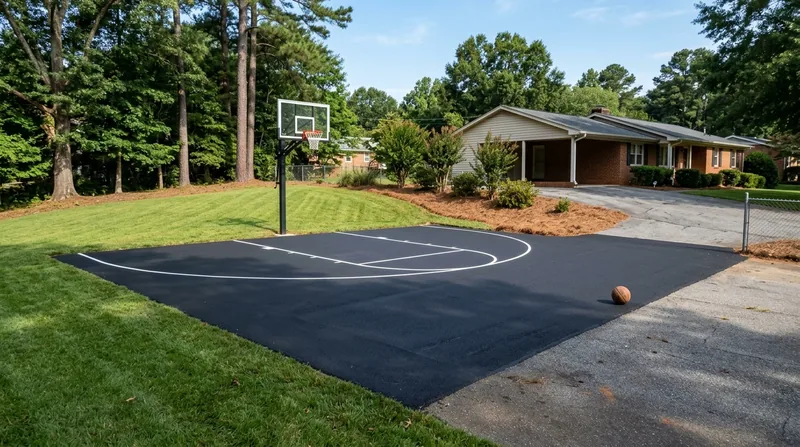




Greenville's rolling Piedmont terrain and freeze-thaw winters create unique challenges for athletic surfaces. A sports court and path paving installation in Greenville demands proper grading for runoff, stable base preparation, and hot mix asphalt sized to handle daily play without cracking under temperature swings. Whether you're building a basketball court in Simpsonville, a tennis surface in Mauldin, or a walking path on a sloped lot west of the Reedy River, the foundation matters more than the surface itself. We grade for drainage, set the base, and lay asphalt that stays level and playable through Greenville's humid summers and icy winters. Since 2016, we've built courts and paths across Greater Greenville, from mill village lots in Monaghan to new HOA subdivisions in Five Forks and Fountain Inn.
Why Sports Court and Path Paving Matters in Greenville's Climate
Greenville sits at the base of the Blue Ridge, where winter temperatures swing from freezing to above 40 degrees Fahrenheit within hours. That freeze-thaw cycle is the single biggest threat to asphalt courts and paths. Water infiltrates small cracks, freezes, expands, and splits the surface wider. A poorly drained court fills with standing water after rain, becomes unsafe, and deteriorates fast. The red Piedmont clay under most Greenville properties drains poorly without intervention, so grading and base prep are not optional. A level court with proper slope and a compacted stone base will outlast a flat one by years.
- Freeze-thaw cracking is the dominant failure mode in Greenville asphalt courts and paths over five to ten years.
- Standing water on a level surface promotes algae growth, safety hazards, and accelerated deterioration.
- Proper slope (typically 1 to 2 percent) sheds rain and keeps courts playable year-round.
- A compacted base of 4 to 6 inches of stone prevents subsidence and keeps the surface stable under foot traffic and equipment.
- Hot mix asphalt sized for athletic use (typically 2.5 to 3 inches) resists cracking better than thin utility paving.
Getting drainage and base prep right during installation saves thousands in repairs later. We start with a site survey and grading plan before any asphalt is laid.
Key info: Greenville and Upstate South Carolina experience 30 to 40 freeze-thaw cycles per winter. A court built on poor drainage will show alligator cracking and settlement within three to five years. A properly graded and compacted court with good drainage typically performs well for eight to twelve years before resurfacing is needed.
For permit and drainage questions specific to your location, check with the City of Greenville Planning and Development Services or your local municipal building department, as rules vary across Greater Greenville.
How We Build a Sports Court or Path in Greenville: Step by Step
A durable court starts with honest site assessment. We visit the lot, measure the slope, check drainage patterns, and identify utilities before we move any earth. Many Greenville properties sit on steep terrain or poor clay, so we adjust the approach based on what's there. If the lot slopes away naturally, grading is straightforward. If it's flat or slopes toward a building, we cut and fill to create proper runoff. We then compact the base, proof-roll it to confirm stability, and lay asphalt in the hot mix size and thickness the court needs.
- We visit the site, measure slope and drainage patterns, and mark any trees, utilities, or structures that affect layout.
- We call South Carolina 811 for a free utility locate before any digging, as required by state law.
- We cut and grade the court pad to establish proper slope (typically 1 to 2 percent for runoff).
- We place and compact a stone base, usually 4 to 6 inches of crushed stone or recycled asphalt millings.
- We proof-roll the base with a heavy roller to confirm it won't settle under traffic.
- We lay hot mix asphalt in 2.5 to 3 inch lifts, compacting each layer to density.
- We stripe the court (if applicable) and inspect the finished surface for level and drainage.
The entire process typically takes one to three weeks, depending on lot size and weather. We can also overlay an existing court if the base is sound and drainage is acceptable.
Local example: A half-court in Greer on a sloped lot required 8 inches of cut on the uphill side and 4 inches of fill on the downhill side to achieve proper drainage. We compacted the base, laid 3 inches of hot mix, and striped it. The court has remained level and drain-free through four winters. A flat court on the same lot would have pooled water by the first spring.
If you have an existing court that needs repair or resurfacing, we also offer asphalt resurfacing and overlay to extend its life without a full rebuild.
Methods and Approaches for Sports Court and Path Paving
| Approach | Description | Best for |
|---|---|---|
| Full-Depth Build | Grading, compacted stone base, and new hot mix asphalt from scratch. | New courts, badly drained or settled existing surfaces, or sites with poor underlying soil. |
| Overlay on Existing Base | Milling the old surface, checking the base, and laying new hot mix asphalt on top. | Courts with sound drainage and a stable base but cracked or worn surface. |
| Grading and Drainage Retrofit | Adjusting slope and adding base material without removing existing asphalt. | Courts that pool water but have structural integrity; common on flat lots in Simpsonville and Fountain Inn. |
| Path Paving (Narrow Runs) | Grading and paving walking or jogging paths 4 to 8 feet wide with proper slope and drainage. | Trails through HOA subdivisions, private properties, or park connectors in Greenville and surrounding areas. |
Sports Court and Path Paving Cost in Greenville: What to Expect
A new basketball or tennis court typically starts at $8,500 for a small half-court on well-drained ground with minimal grading. A full court, a sloped lot requiring significant cut and fill, or a path longer than 200 feet will cost more. The biggest cost drivers are site grading, base prep, and asphalt thickness. A court on steep terrain or poor clay soil costs more to build right than one on flat, well-draining ground. Overlay projects (resurfacing an existing court) cost less than full-depth builds because the base and drainage are already in place.
We always provide a written estimate after a site visit, with tonnage, thickness, and grading scope spelled out. We recommend getting two or three estimates from local paving contractors so you can compare methods and pricing. The cheapest estimate is often the riskiest, especially if it skips base prep or uses thin asphalt. The best estimate explains what you're getting and why it costs what it does.
See our full pricing overview for more detail on service-by-service costs and factors that move the price up or down.
Sports Court and Path Paving Near Me: What Greenville Homeowners Should Know When Hiring
Hiring the right paving contractor is the difference between a court that lasts eight years and one that cracks in three. Start by asking any contractor for references from recent court or path jobs in Greenville or nearby towns like Greer, Simpsonville, or Mauldin. A local contractor with a local address and local phone number is a stronger signal than an out-of-state crew. Ask to see a recent estimate so you can verify it includes site grading, base prep, tonnage, asphalt thickness, and drainage details. If an estimate is vague or missing those details, keep looking.
Check whether your site requires a municipal permit for grading or paving. In Greenville, some jurisdictions require permits for work on slopes or near drainage easements. If your court is in an HOA subdivision, the HOA may have design standards or architectural approval requirements. We help homeowners navigate local permitting and HOA rules, but the final responsibility is yours. Call your local building department or HOA before you commit.
Ask any contractor whether they pull utilities (call SC 811 before digging). If they don't, walk away. Hitting a gas line or electrical line is not only dangerous, it's expensive and a sign the contractor cuts corners. Ask for proof of insurance and a written contract with a start date, scope, and payment schedule. Never pay cash upfront or agree to a large deposit before work starts. A reputable contractor will invoice you as work progresses or at completion.
For a free, no-obligation estimate on a sports court or path in Greenville, contact us at (864) 385-2398. We'll visit the site, answer your questions, and give you a written estimate within 24 hours.
Sports Court & Path Paving in Greenville: Pricing Guide
| Service | Price | Details |
|---|---|---|
| Half-Court (Basketball or Tennis) | Starting at $8,500 | Includes grading, compacted base, and 2.5 to 3 inches of hot mix asphalt on level or gently sloped ground |
| Full Court or Large Pad | Starting at $14,000 | Larger footprint, more grading and base material, and increased asphalt volume; sloped terrain adds cost |
| Walking or Jogging Path (per 100 linear feet) | Starting at $2,200 | 4 to 8 feet wide with proper grading, base, and drainage; longer paths and steep slopes increase total cost |
| Overlay (Resurfacing Existing Court) | Starting at $4,500 | Milling old surface and laying new asphalt; cost depends on court size and condition of existing base |
| Site Visit and Written Estimate | Free | We measure, assess drainage and grading needs, and provide a detailed estimate with tonnage and thickness |
Indicative pricing, the exact cost depends on square footage, finish, and site access. Free personalized estimate within 24h at (864) 385-2398.


